
Why TalkPlaya Uses Pre-Written Prompts Instead of Child-Facing AI
Practical product guide. It does not provide medical advice or guarantee sleep, behavior, language, or relationship outcomes.
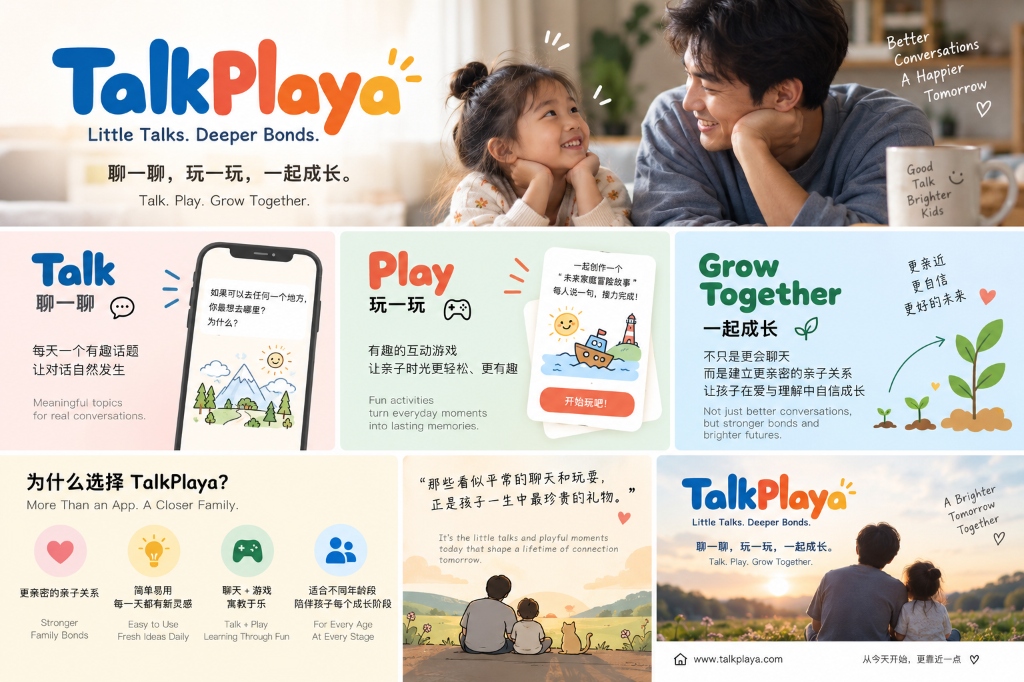
Some family products place a generative chatbot in front of a child and allow open-ended questions with generated replies. TalkPlaya chooses a different product boundary.
The child-facing card flow reads only pre-written prompts. It opens no generative chat and provides no recorder or text field for a child’s spoken answer.
This choice follows the inspectable product scope rather than a medical, neuroscience, or attachment-outcome claim.
1. Every Card Can Be Reviewed Before Use
TalkPlaya’s 28 English and Chinese nights live in versioned content files. A deterministic rule selects a seven-night voyage; the runtime does not generate a new question for the child.
Each card has a question, grown-up-first line, follow-up, play modes, avoid line, stop rule, and closing. A grown-up can review these fixed fields before use.
2. The Answer Stays in the Real Conversation
After the card displays an opening, the answer happens between the grown-up and child. The product has no audio recorder, transcript, or free-text answer field and does not generate a profile from what the child says.
A child can Talk, Draw, Act, Guess, make a Story, pass, change the topic, choose quiet presence, or stop.
3. Local Progress and Optional Backup Are Separate Data Paths
Without sign-in, family profiles, the seven-night plan, and completion progress stay in browser storage. After a grown-up signs in, the configured API can receive the same profile state as a backup.
Sign-in and backup make network requests, so TalkPlaya does not claim to be absolutely offline or network-free. Existing A4 PDF cards are available when a family wants a paper option.
4. Technology Provides a Finite Opening
TalkPlaya does not replace a caregiver or score a family relationship. It provides these inspectable behaviors:
- **Adults Share First**: Every card includes a first line.
2. **Children Can Decline**: Pass, change, quiet presence, and stop carry no score penalty.
3. **Three Age Stages**: Ages 3–6, 7–11, and 12–15 use different wording.
4. **Web and Print Entry Points**: The web experience covers ages 3–15; current A4 printables cover ages 3–8.
These are current product behaviors, not promises about sleep, psychology, or relationship outcomes.
Free Screen-Free Printable Cards (A4 PDF)
Prefer to keep screens away from bedtime? Download our ready-to-print conversation cards and 7-night moon habit tracker. Free PDF, no account required.
Download Printable Cards ➔Try One Pre-Written Prompt Tonight
Open one night in the browser, or use the free printable cards for a paper option.